Tuesday, November 10, 2015

Inquiry Design Model

I was really interested the see the c3 teachers inquiry design model. I think it was a great template that teachers can follow when design an inquiry lesson. I felt that that when I planned the inquiry lesson it was one of the hardest to come up with and plan for. This was a very explicit design model that states exactly what you need. 
I really liked how the model helped build on the student knowledge. The supporting questions was a great idea to help scaffold the children into understand the bigger question that the lesson is addressing. 
It is also set up in a way that each supporting questions comes with a task that comes with a source. In this model everything is linked together and goes hand in hand. This is something that I can definitely use when I have to plan my inquiry lessons

Wednesday, November 4, 2015

Fun Ways to Teach Geography!


When I was in school learning about geography, it was pretty boring, Not a lot of teachers tried to make it overly fun or engaging for the students so below I listed some ways that when I am a teacher I would like to use in my classroom!
Adopt a Rock
This idea includes bringing a rock into class and having the students identify where it may have came from, how it was shaped and things like that. Then students can take turns taking the rock home and creating a scrapbook of the rocks adventures! 
Bingo
Everyone knows bingo. I think it could be really fun and great way to review vocabulary by putting down terms on their bingo cards and reading out the definitions! The students will have to listen to the definition and read their terms and match the definition to their terms until someone gets bingo!
Creating Models
I really liked the idea of using the plasticine to create physical features. It can be used to create mountains, valleys, canyons or many other things. It is a more hands on way to learning these features that we see everyday!
Stop Disasters!
I really thought the online stop disasters games was really interesting. I think this was a very fun and captivating way to teach about the effects of natural disasters. I particularly liked how it teaches the students how they can help prevent the disasters and gives them facts to help them.It really is a great learning tool. 
Landscape in a box!
I thought this idea was really interesting and creative. The students can be assigned an area and can create a landscape in a burger box based on the area. This involves students doing a hands on project while doing research on their area. These would be great to display around the classroom!
Before and After pictures!
In this activity students are shown a picture of something and have to make prediction on what happened before the picture and what could have happened after the picture. Students will need to infer from the picture. This works on many different skills
Model your Place on a Paper Plate
This is similar to the burger box one but its more of building on a paper plate. Students can remodel the play ground outside and add more features to how they would like it to be. Or they can change their backyard around and add ponds or trees or anything they can think of 
Shanty Town Game
In this game students have to build a shack in order to protect their children from the rains. Students will be given materials to start to build with and then can "work" in order to get other materials at the teachers discretion. This "work" could be short informational activities. After about a half hour the rain will come and whoever's child remains the most dry wins!
Where is that game?
Before this game the teacher goes around the school and takes pictures at weird angles, close ups, or anything else the teachers can think of to challenge the students observational skills. The students will be given these pictures and have to identify where these pictures were taken. The group who gets the most right wins.
Atlas Race
I like the idea of the atlas race because it exposes the class to places they have never heard of before while teaching them atlas skills. They can also right a brief response on that place once it is found in order to gain more knowledge! 


Pre and Post tests!


During our fieldwork we have to create a pre-test to see what our students already knew! Creating this pretest was more challenging because every group had to contribute questions from their topics. It was also kind of hard to decide what questions we wanted to asked them before we had really fully developed our lesson plans. We weren't sure what aspects we were going to put emphasis on. 
After our fieldwork was over we had to contribute to the post test. We used two questions from the pre-test and two new questions. I thought this was easier because we knew what the goal of our lessons were and what the students should have come away with. I am very curious to find out how the students do on this test because it will show how well we taught our lessons!

Thursday, October 29, 2015

Fieldwork Experience


We have just come to the end of our field work experience! I had a great time working with the fifth grade students and I really learned a lot through this experience. I learned that writing a lesson takes a lot of time and preparation. Many things go into planning a lesson and you shouldn't start it at the last minute. One thing that I learned is that although on paper a lesson may sound great it may not always go as planned when run in a classroom. All students respond differently to different lesson. I also learned that I really need to work on not saying the words "guys". It was really hard for me not to say it. I really enjoyed teaching the lesson and the activities we had because I think they were very effective and a lot of fun. I also learned that you need to rehearse and over plan! The more we rehearsed the better it ran.

When working with this class I discovered that managing a classroom is harder than it looks. With a classroom full of 30 fifth grade students things can get rowdy pretty quickly if you are not in control. It was also hard to tailor to every students needs in the class. I noticed that we need to pay attention to particular students because some work better together than others. There are so many different personalities at play in a classroom and because of this students don't always get along when doing group work. In the groups in our classroom students often resulted to name calling and being mean to one another. This taught me that I need to teach how to be a good group member and how to be respectful to one another. I think this will be easier in my future classroom because I will know how my students work better.

I feel that my expectations were met in this experience. I really expected to learn a lot from finally being able to teach a full class and I can honestly say I did. I learned so much about planning and how to be a presence in front of the classroom. I was able to watch my peers teach and learn from them as well. 

I had always worried that I would be too quiet in front of classroom because I don't have a loud voice. After this experience I know that I have what it takes to be a classroom teacher. I know now that I can take charge and be flexible. I can write an effective lesson plan and teach in many different ways. This experience just made me more excited for my future.

Team teaching is also harder than expected. We had a hard time meeting and were left to plan things all at once. We had so many different ideas going around that it was hard to agree on one idea and plan it. Working as a group brings together many different challenges, but we over came those challenges in order to make an effective lesson. It was also a little unrealistic because I don't think in my future teaching I will ever be working to teach one lesson with five teachers! I think the students enjoyed this because they had different voices and views from each teacher. 


Friday, September 25, 2015

The Jigsaw Method


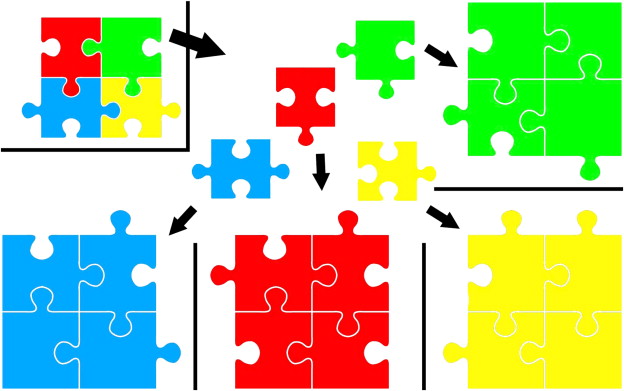
This week and class we implemented the jigsaw method of learning. We were involved in two different groups, base groups and expert groups. In our base groups we were all assigned a number and a topic that went along with that number. In the above picture this is represented by the colored puzzle. We then split, like the puzzle pieces, and joined our expert groups. In these groups we researched our topic and became "experts". After researching we returned to our base groups and taught them about our topic. So we had five different experts in our group!
I liked this idea because we were able to become experts in one topic and by reteaching the topic we really had a deeper understanding. The problem I did have with this method was that it was hard to retain knowledge that the other experts taught. So although I am an expert in one topic I only had a small grasp on the other topics. I liked how we had to tests because that helped me test my knowledge and review so I became more comfortable with the material 

Wednesday, September 23, 2015

Cooperative Learning

Cooperative Learning!
Positive Interdependence: When members understand that they must work together to achieve the goal they promote a more positive environment. 
- Higher Achievement 
-More Time Spent on Task
- Critical Thinking
- Higher Self Esteem 
-Helps cope with Stress
-More students succeed 
Three different types of cooperative learning groups
Formal- one class to a few weeks
Informal- a few minutes
Cooperative- long term 
Individual Accountability:Taking responsibility of your part of the group 
The purpose of the group is to make each member stronger and more likely to succeed.
How to ensure group accountability  
Groups should be small and manageable 
Individual tests to each group member
Random oral exams to students 
Assigning roles to each student 
 Group Processing: is when students work together while the teacher monitors and the students discuss off of each others ideas. 
4 parts
-Feedback
-Reflection
-Improvement goals
- Celebration 
Purposes
- Improve working together over time
-Streamlines progress
-Increase individual accountability 
-Reduces negativity
Social Skills: Interacting with others
Six Outcomes
1. Personal Identity 
2. Life Success 
3. Quality of Life
4. Mental Health
5. Physical Health
6. Ability to Cope with Stress
The Four "F" Skills
FormingThe basic skills needed for a functioning, cooperative learning group.
FunctioningThe skills needed to manage the group’s activities to complete a task and to maintain effective working relationships among members.
Formulating:The skills needed to understand the material being studied at a deeper level, to stimulate the use of higher quality reasoning strategies, and to maximize retention.
FermentingThe skills needed to rethink the material being studied, manage cognitive conflict, search for more information, and communicate the rationale behind one’s conclusion.
Four Phases of Learning Social Skills
1. Awkward
2. Phony
3. Mechanical
4. Integrated


Tuesday, September 22, 2015

Bloom's Taxonomy


Knowledge: The lowest level of the cognitive domain. It is about recalling information. 
Examples include knowing facts, theories, principles etc. 
Verbs included are: define, list, state, identify
Comprehension: The second level of the cognitive domain. This level is about the meaning of information. It's one step beyond recalling information.
Examples include understanding facts and principles, interpreting charts and graphs, justify methods and procedures.
Verbs included are: Explain, predict, interpret, infer, summarize
Application: The third level of the domain. This is the ability to use the new information to concrete situations. It is a higher level of understanding than comprehension.
Examples included are apply concepts and principles to new situations, apply laws and theories to practical situations
Verbs included: How would you show, make use of, modify, demonstrate, solve, or apply
Analysis: The fourth level of the domain. The ability to break down material into its components.It requires an understanding of both the content and the structural form of the material.
Examples included are: recognize unstated assumptions,and distinguish between facts and inferences.
Verbs used: Differentiate, compare / contrast, distinguish
Evaluation: the highest level. It involves judging the materials value. It contains a little bit of all the other parts of the domain. 
Examples include: Judge the consistency of the written work or judge how the conclusions are supported by the data. 
Verbs: Justify, appraise, evaluate, judge 
Creating: Putting parts together to make a new whole. It stresses creative behaviors, with emphasis on the formulation of new patterns or structure.
Examples are  write a well organized paper, give a well organized speech, write a creative short story
Verbs include: Design, construct, develop, formulate, imagine, create, change